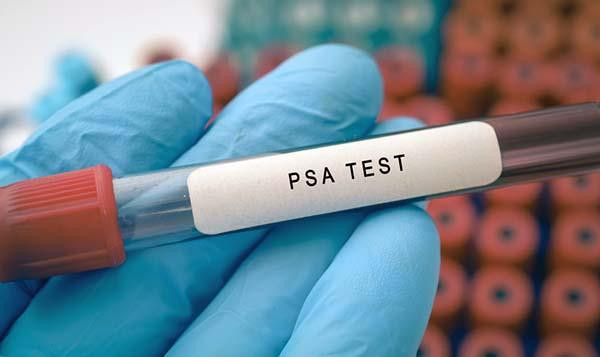
PSA testing: Screening for prostate cancer

All prostate cells make PSA, a protein that helps to dissolve semen so that sperm cells can more easily reach and fertilize an egg. Normal and cancerous cells in the prostate each make PSA in similar amounts. But since cancer cells are leakier, they release more of the protein into the bloodstream.

You may be interested in…

A Guide to Men’s Health Fifty and Forward

In this Special Health Report, you’ll learn the steps, strategies, and secrets that can help you defy age-related illnesses, stay physically and mentally fit, boost your sexual vitality, and add to your longevity. You’ll find that by doing the “right things” with consistency and commitment, you can protect yourself against serious illness, postpone the signs of aging, and enjoy years of active living. What are the “right things”? In Men’s Health: Fifty and Forward, you’ll be introduced to 41 changes and choices that matter. Some you may know. Some will be new. All will be helpful. Whether you want to reduce your risk of heart attack and stroke or boost your stamina and staying power, this report will give you the information you need for the tomorrows you want.

LEARN MORE

PSA screening for prostate cancer came into widespread use during the early 1990s. But the test is controversial: prostate cancer grows slowly, and the concern is that PSA screening flags too many low-grade tumors that might not be harmful during a man’s life. Still, studies do suggest that PSA testing, because it can detect cancers at early and more treatable stages, can be lifesaving in some cases.

The US Preventive Services Task Force (USPSTF), an influential volunteer panel of experts in prevention and evidence-based medicine, takes a cautious stance on the matter. The USPSTF advises doctors to discuss the pros and cons of PSA screening in men ages 55 to 69, but also cautions against screening men over the age of 70, and gives no recommendation at all for men under 55.

Some expert groups recommend earlier screening for men in higher-risk groups. Black men, for instance, are about twice as likely to be diagnosed with and die from prostate cancer than white men. The American Cancer Society (ACS) advises PSA screening for Black men at age 45, or even earlier screening for men with first-degree relatives who developed prostate cancer at young ages, as well as for men who test positive for mutations in certain cancer risk genes, such as BRCA1 and BRCA2.

Importantly, activities that put pressure on the prostate gland (such as biking and sex) can cause PSA levels in blood to spike, so you should refrain from these activities for two to three days prior to testing. Health conditions affecting the prostate, such as infections, inflammation (prostatitis), or enlargement of the gland that occurs normally in older men (benign prostatic hyperplasia), can also cause PSA levels to spike in ways that are unrelated to cancer.

What is an abnormal PSA result?

In general, PSA levels over 4 nanograms per milliliter (ng/mL) in blood are considered abnormal. But doctors may also vary PSA cutoffs by age. For instance, a PSA of 3.5 ng/mL for a man in his 40s “is definitely abnormal,” says Dr. Marc B. Garnick, the Gorman Brothers Professor of Medicine at Harvard Medical School and Beth Israel Deaconess Medical Center, and editor in chief of the Harvard Medical School Guide to Prostate Diseases. However, a PSA of 5.5 ng/mL among men in their 60s, Dr. Garnick adds, may not be. It’s best to think of PSA values as being on a continuum, with higher levels associated with having prostate cancer.

What Every Man Should Know About Preventing and Treating Prostate Problems

Guide to Prostate Diseases

Most men eventually develop some type of prostate problem, and when they do there are usually no easy solutions. More than a primer on prostate conditions, this Special Health Report, the 2026–2027 Harvard Medical School Guide to Prostate Diseases, includes roundtable discussions with experts at the forefront of prostate research, interviews with men about their treatment decisions, and the latest thinking on complementary therapies. This report will provide you with the information you need to understand the current controversies, avoid common pitfalls, and work with your doctor to make informed choices about your prostate health.

Learn More!

PSA testing can sometimes miss a cancer diagnosis altogether. One study found that up to 15% of men with PSA levels under 4 ng/mL actually did have prostate cancer, and a sizeable fraction of these tumors were clinically significant. It’s also possible for high-grade cancer to be present without causing a large increase in PSA. That’s because high-grade cancer cells can lose their ability to actually make the protein.

What are next steps after an abnormal result?

It used to be that elevated PSA readings were followed routinely by a prostate biopsy, and then treatment if cancer was detected.

Today the paradigm is shifting. An abnormal result is now likely to be followed by a magnetic resonance imaging (MRI) scan, which can identify areas of the prostate gland that look suspicious for cancer. In Europe and some hospitals in the US, men with abnormal PSA readings might avoid an initial biopsy altogether if the MRI results are negative. However, many physicians will still opt for an initial biopsy in such cases, followed by periodic PSA tests and MRI scans to determine if further biopsies are needed.

If the initial biopsy and MRI results are positive, then doctors will perform a targeted biopsy focused on areas where the MRI showed evidence of cancer. If a cancer diagnosis is confirmed, then next steps will be initiated. Today, many low-grade cancers are watched with active surveillance, and treated only if follow-up biopsies and MRI scans show worsening of the disease. Higher-grade cancers will be treated immediately.

“The goal of this risk-adapted approach to screening,” Dr. Garnick says, is to “identify clinically significant cancers that actually do need treatment while decreasing diagnoses of clinically insignificant cancers that do not.”

Variations on the PSA test

Rather than subject everyone with an elevated PSA reading to a biopsy, some doctors perform additional tests that involve more detailed interpretations of PSA levels.

  • Free PSA testing looks for PSA that isn’t bound to other proteins. Low percentages of free PSA are associated with higher cancer risk.
  • PSA density divides the total PSA level in ng/mL by the volume of the prostate gland in milliliters. A PSA density of 0.15 ng/mL or higher may be associated with prostate cancer.
  • PSA velocity tracks how fast PSA levels increase from test to test.
  • Prostate Health Index combines total PSA, free PSA, and a type of PSA called proPSA. Some evidence suggests it diagnoses prostate cancer more accurately than PSA by itself.

Leave a Reply

Your email address will not be published. Required fields are marked *